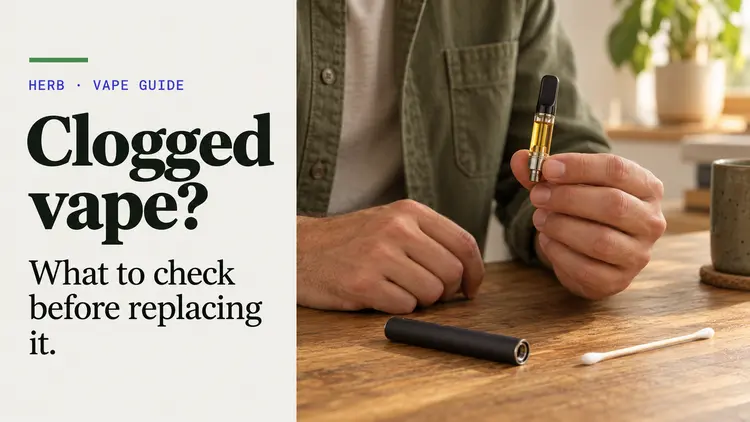
You pick up your vape, take a draw, and get almost nothing. There is still oil in the cartridge. The battery lights up. Yet somehow, your supposedly convenient device has become another thing that needs troubleshooting.
Before you replace it, figure out what actually stopped working.
A vape can clog when oil or sticky residue restricts its airflow. Cold temperatures, heat exposure, storage position, and forceful draws can contribute. But a dead battery, poor connection, or empty cartridge can also leave you with no vapor. The right fix depends on which problem you have.
This guide covers prefilled cannabis cartridges, pods, and all-in-one vapes for adults. Dry herb vaporizers and refillable nicotine tanks require different maintenance. Your device’s instructions should guide any cleaning, charging, or preheating.
First, is your vape actually clogged?
Pay attention to how the draw feels before changing settings.
- Air barely moves: Check the mouthpiece and air openings for obstruction.
- Air moves normally, but there is no vapor: Check power, connections, and the oil level.
- The device gurgles or sends oil toward your mouth: Stop drawing; oil may have entered the airflow path.
- The light flashes: Look up the exact indicator pattern in the manual. Flashing does not have one universal meaning.
These observations narrow the possibilities; they do not prove a diagnosis. A cartridge can have more than one problem, and an illuminated battery does not guarantee that the heating element is working correctly.
O.pen’s troubleshooting guide identifies battery charge, electrical connections, cartridge problems, and compatibility as separate things to investigate. That distinction can save you from replacing the wrong part.
Try to remember when the trouble started. A vape that never worked out of the package needs a different conversation with the retailer from one that stopped working after weeks of use. Note whether it followed a drop, time in a hot car, a battery change, or cleaning.
Also, change one thing at a time. If you adjust the voltage, swap batteries, and clean everything together, you lose useful clues about what helped. Start with the simplest check, reassess, and stop once the problem is resolved. Repeatedly testing a device that leaks or overheats adds risk without giving you a better diagnosis. Keep damaged equipment out of these checks and contact its manufacturer for specific guidance instead.
Why does a vape keep clogging?
Cold oil moves more slowly
Cannabis oil becomes thicker as it gets colder. That can interfere with its movement toward the heating element and make existing residue harder to clear. A device that struggles after sitting somewhere cold may need time to return to normal room temperature.
However, thick oil in the reservoir does not automatically mean the mouthpiece is blocked. Restricted airflow and poor oil flow are related troubleshooting possibilities, but they are different problems.
Excessive heat can encourage leaking
Heat makes oil thinner, allowing it to move into places where it should not collect. A vape left in a hot car may develop leaking or airflow problems even though the oil looks perfectly fluid.
CCELL explains both temperature effects. The practical lesson: stable storage temperatures matter. In Los Angeles, that means your glove compartment is a particularly poor permanent home for a vape.
Residue builds up around the airway
Condensed vapor and oil residue can accumulate around the mouthpiece. Dust or pocket debris can also obstruct exposed openings. A little buildup may first feel like a tighter draw before becoming more noticeable.
O.pen’s disposable troubleshooting resource lists dirt, dust, and condensation among potential airflow obstructions. Look for visible residue before assuming the entire device has failed.
Strong pulls and storage habits can contribute
Pulling harder is an understandable reaction when a vape feels blocked. Unfortunately, forceful draws can pull excess oil through the system and contribute to flooding. Leaving a cartridge lying sideways can also encourage oil to collect where it affects airflow.
O.pen’s care guidance recommends moderate draws and upright storage. If the same problem keeps returning, those habits are worth reviewing alongside the hardware itself.
What to check before replacing your vape
1. Identify the device and inspect it
Start with the product name and model. A screw-in cartridge, a proprietary pod, and a sealed disposable do not come apart or operate the same way.
Read the packaging or manufacturer’s instructions. Check whether the device has a power lock, a charging port, or a designated preheat function. Remove any shipping plugs or protective covers exactly as directed.
Then look for cracked glass, leaking oil, a damaged charging port, or a distorted housing. If the device is damaged, unusually hot, or activating by itself, stop using it. Those symptoms call for support or replacement, not another attempt to clear the airway.
2. Inspect the mouthpiece and external air openings
Turn the device off if it has that option. Examine the mouthpiece in good light and check that your fingers are not covering an air inlet during use.
Gently remove accessible surface debris with a clean, dry swab or the cleaning tool specified by the manufacturer. Keep loose fibers out of the opening. Do not push residue farther inside or pry off a sealed mouthpiece.
Some devices need very little cleaning. For example, PAX’s TRIP instructions permit a dry cotton swab around the mouthpiece and explicitly warn against opening the device. Treat that as a reminder to check your own model before attempting deeper maintenance.
3. Let a cold device return to room temperature
If the vape has been somewhere cold, bring it indoors and leave it upright, following its storage instructions. Allow it to reach ordinary room temperature before trying again.
Gentle hand warmth may help with a cold cartridge or pod. PAX recommends warming a clogged Era pod in your hands as an initial step.
Avoid direct heat. A lighter, microwave, stove, or hot water bath is not an appropriate shortcut for a device containing oil, seals, electronics, and a battery.
If it was overheated instead, let it cool naturally. Do not put it in a freezer or charge it while it remains hot.
4. Check power and charging
If air moves freely but no vapor appears, confirm that the battery is on, unlocked, and charged according to its instructions.
Only charge a device designed to be rechargeable. The word “disposable” alone does not answer that question: some all-in-one products support charging, while others do not.
Use the charging equipment specified by the manufacturer. Charge where you can see the device, on a clean, flat surface away from bedding and other flammable materials. The FDA’s vape battery guidance also advises avoiding extreme temperatures during charging.
Charging can resolve a power problem. It will not physically remove debris blocking the mouthpiece.
5. Check removable connections
For a cartridge or pod designed to detach, remove it with the device powered off. Look for residue on the accessible contact surfaces.
Follow the manufacturer’s cleaning method. Jupiter Research recommends a cotton swab lightly dampened with isopropyl alcohol on the contact points of its devices, followed by thorough drying before reuse.
That does not mean pouring alcohol into a cartridge, soaking a battery, or cleaning the oil chamber with solvent. Keep liquids away from internal electronics and follow your model’s instructions.
Reattach the cartridge or pod gently. A threaded connection should fit securely without being forced. Do not lift contact pins with metal tools or modify the battery to make a cartridge connect.
6. Use preheat only if your device supports it
A designated preheat or anti-clog function may help with thickened oil. Follow the exact activation instructions and limits for your model.
These functions vary. PAX’s Era Go guide, for example, describes an anti-clog feature activated by removing and reinstalling its pod. That procedure should not be treated as a universal instruction for other products.
Do not improvise by holding down a firing button indefinitely or repeatedly running heating cycles. Likewise, increasing voltage to the maximum is not a reliable way to identify or fix a blockage.
If the approved procedure does not help, move on to support rather than adding more heat.
7. Separate a cartridge problem from a battery problem
If you already have another undamaged, manufacturer-compatible cartridge or battery, a comparison may help identify the failing component. Only test equipment that is clean, intact, and free of leaking oil.
Does another compatible cartridge work on the same battery? That points toward the original cartridge. Does the original cartridge work on another approved battery? The first battery or its connection deserves closer attention.
These are clues, not guarantees. Matching threads alone does not establish compatibility: Jupiter’s care guide warns that mixing unsupported components can create problems.
A sealed all-in-one device does not offer this comparison. Keep it sealed and contact the seller or manufacturer.
How to reduce recurring clogs
Once the vape works again, consider what happened before each blockage. Did it spend the afternoon in the car? Was it lying in a warm bag? Does trouble appear with one cartridge or across several?
A short note on your phone can make the pattern easier to explain to support. Record the product, battery model, setting, and circumstances. You do not need an elaborate maintenance diary.
Follow the maker’s storage guidance, generally keeping oil cartridges upright and away from direct sunlight and extreme temperatures. Keep the mouthpiece clean and protected using its intended cover or case. Use gentle, steady draws and pause between them.
For adjustable devices, stay within the cartridge manufacturer’s recommended operating range. There is no single voltage setting that suits every oil and heating element.
O.pen’s airflow guide emphasizes upright storage, clean openings, and an appropriate connection. If those basics do not prevent repeated failures, the product may need replacement.
When should you stop troubleshooting?
A vape should not require a repair project before every use. Contact the retailer or manufacturer when basic, approved troubleshooting fails, especially with a recently purchased product.
Stop using a device with persistent leaking, cracked components, recurring hot oil at the mouthpiece, or an ongoing burnt taste. Stop using or charging a battery that becomes abnormally hot, swells, or behaves unpredictably. Do not open a sealed unit to rescue the remaining oil.
Keep the receipt, packaging, batch information, and photographs of visible problems. Describe what happened and which approved steps you tried. Ask about the seller’s actual replacement policy; an exchange is not automatically guaranteed.
For battery-containing devices, check local disposal options. The EPA advises keeping lithium-ion batteries and products containing them out of household trash and curbside recycling. Confirm that a collection program accepts the whole vape before taking it there.
Common questions about clogged vapes
Why does my vape clog overnight?
Review its overnight storage first. A colder room, a sideways position, or existing residue may help explain why the first draw is difficult. If correct storage does not change the pattern, report the recurring problem rather than repeatedly forcing it clear.
Can a cartridge have oil left and still need replacing?
Yes. Visible oil does not prove that the heating element, seals, or airflow path still function. A thin coating on the glass also does not guarantee a usable amount remains. O.pen’s empty-cartridge guide recommends considering oil level, vapor production, and burnt taste together.
Should I use a needle or paper clip?
Avoid improvising with sharp objects inside sealed cartridges or all-in-one devices. You can damage internal parts or push residue deeper. Stick to accessible exterior cleaning and procedures explicitly approved for your model.
Does clogging mean the oil is bad?
Clogging alone cannot establish oil quality. Storage conditions, hardware, and residue can produce similar symptoms. If a new product repeatedly fails, share the details with its seller instead of guessing from the blockage alone.
Before buying another vape, check airflow, temperature, power, and connections. If it still fails after the manufacturer’s basic troubleshooting, stop experimenting and ask about replacement. Saving a little remaining oil is not worth continuing to use damaged hardware.